13 Manual 3-Step Covariate Only
Data source:
The first examples utilizes the public-use dataset, The Longitudinal Survey of American Youth (LSAY): See documentation here
The second example utilizes a dataset on undergraduate Cheating available from the
poLCApackage (Dayton, 1998): See documentation here
13.1 Load packages
library(MplusAutomation)
library(tidyverse) #collection of R packages designed for data science
library(here) #helps with filepaths
library(janitor) #clean_names
library(gt) # create tables
library(cowplot) # a ggplot theme
library(DiagrammeR) # create path diagrams
library(glue) # allows us to paste expressions into R code
library(data.table) # used for `melt()` function
library(poLCA)
library(reshape2)
Our example is Mother’s Education as a predictor of latent class membership of Math Attitudes
Application: Longitudinal Study of American Youth, Science Attitudes
| LCA Indicators & Auxiliary Variables: Math Attitudes Example | |
| Name | Variable Description |
|---|---|
| enjoy | I enjoy math. |
| useful | Math is useful in everyday problems. |
| logical | Math helps a person think logically. |
| job | It is important to know math to get a good job. |
| adult | I will use math in many ways as an adult. |
| Auxiliary Variables | |
| mothed | Level of education: (1) less than high school, (2) high school diploma, (3) some college, (4) 4-year college, and (5) an advanced degree. |
The data can be found in the data folder and is called lsay_subset.csv.
lsay_data <- read_csv(here("three_step","data","lsay_subset.csv")) %>%
  clean_names() %>%   # make variable names lowercase
  mutate(female = recode(gender, `1` = 0, `2` = 1)) # relabel values from 1,2 to 0,1
13.2 Descriptive Statistics
dframe <- lsay_data %>%
pivot_longer(
c(enjoy, useful, logical, job, adult),
names_to = "Variable"
) %>%
group_by(Variable) %>%
summarise(
Count = sum(value == 1, na.rm = TRUE),
Total = n(),
.groups = "drop"
) %>%
mutate(`Proportion Endorsed` = round(Count / Total, 3)) %>%
dplyr::select(Variable, `Proportion Endorsed`, Count)
gt(dframe) %>%
tab_header(
title = md("**LCA Indicator Endorsement**"),
subtitle = md(" ")
) %>%
tab_options(
column_labels.font.weight = "bold",
row_group.font.weight = "bold"
)| LCA Indicator Endorsement | ||
| Variable | Proportion Endorsed | Count |
|---|---|---|
| adult | 0.596 | 1858 |
| enjoy | 0.573 | 1784 |
| job | 0.625 | 1947 |
| logical | 0.541 | 1686 |
| useful | 0.589 | 1835 |
Mother’s Education
13.3 Manual ML Three-step
13.3.1 Step 1 - Class Enumeration w/ Auxiliary Specification
This step is done after class enumeration (or after you have selected the best latent class model). In this example, the four class model was the best. Now, we re-estimate the four-class model using optseed for efficiency. The difference here is the SAVEDATA command, where I can save the posterior probabilities and the modal class assignment that will be used in steps two and three.
step1  <- mplusObject(
  TITLE = "Step 1 - Three-Step using LSAL",
  VARIABLE =
  "categorical = enjoy useful logical job adult;
   usevar = enjoy useful logical job adult;

   classes = c(4);

   auxiliary =  mothed  ! covariate ",

  ANALYSIS =
   "estimator = mlr;
    type = mixture;
    starts = 0;
    optseed = 568405;",

  SAVEDATA =
   "File=savedata_cov.dat;
    Save=cprob;",

  OUTPUT = "residual tech11 tech14",

  PLOT =
    "type = plot3;
    series = enjoy-adult(*);",

  usevariables = colnames(lsay_data),
  rdata = lsay_data)

step1_fit <- mplusModeler(step1,
                            dataout=here("three_step", "manual_3step", "Step1.dat"),
                            modelout=here("three_step", "manual_3step", "one_cov.inp") ,
                            check=TRUE, run = TRUE, hashfilename = FALSE)
source(here("functions", "plot_lca.R"))
output_lsay <- readModels(here("three_step", "manual_3step","one_cov.out"))

plot_lca(model_name = output_lsay)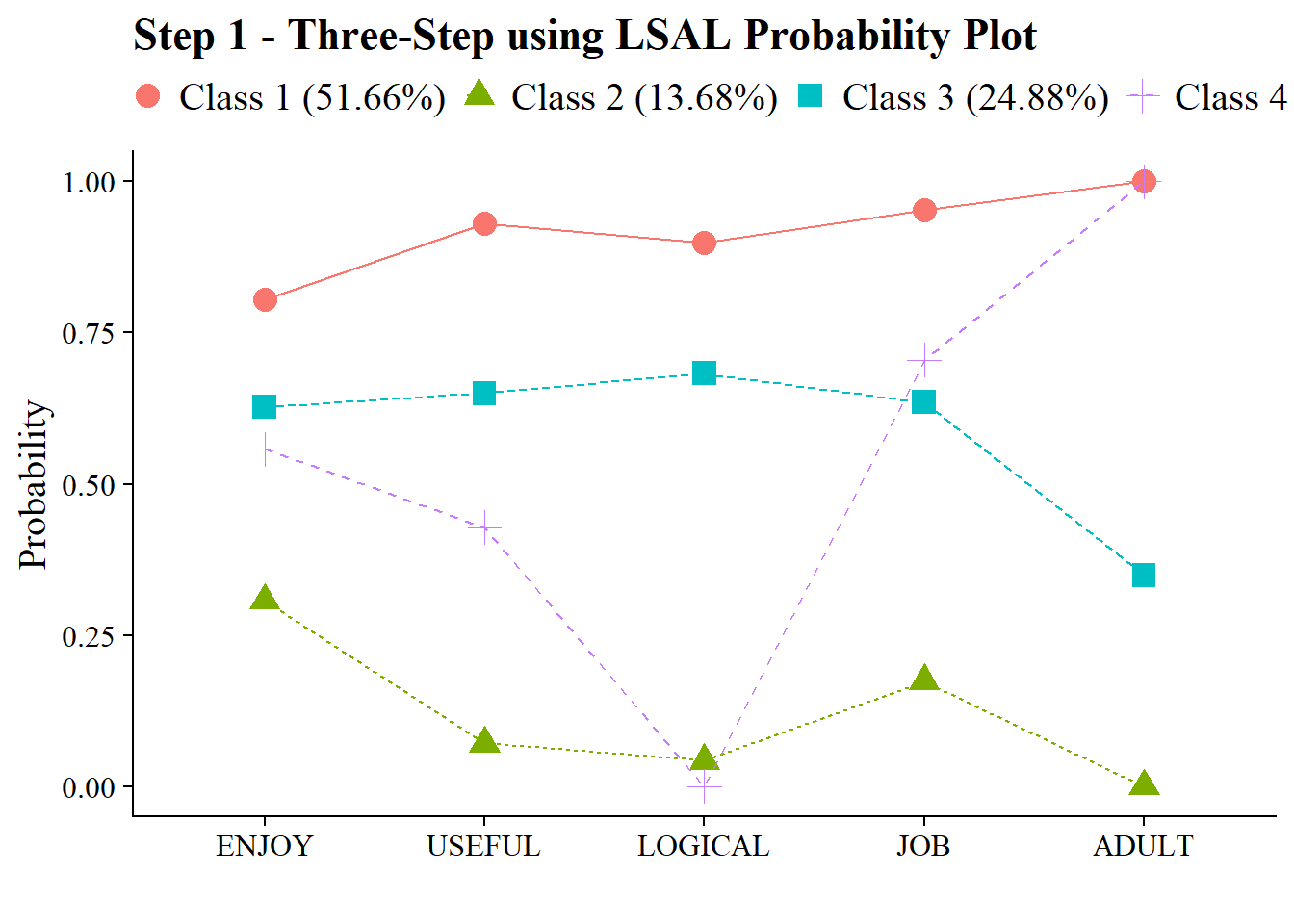
13.3.2 Step 2 - Determine Measurement Error
Extract logits for the classification probabilities for the most likely latent class
logit_cprobs <- as.data.frame(output_lsay[["class_counts"]]
                                       [["logitProbs.mostLikely"]])
Extract saved dataset which is part of the mplusObject “step1_fit”
savedata <- as.data.frame(output_lsay[["savedata"]])Rename the column in savedata named “C” and change to “N”
13.3.3 Step 3 - LCA Auxiliary Variable Model with 1 Covariate
step3  <- mplusObject(
  TITLE = "Step3 - 3step LSAY",

  VARIABLE =
 "nominal=N;
  usevar = n;

  classes = c(4);

  usevar = mothed;" ,

  ANALYSIS =
 "estimator = mlr;
  type = mixture;
  starts = 0;",

  DEFINE =
   "center mothed (grandmean);",

  MODEL =
  glue(
 " %OVERALL%

  C on mothed;        ! covariate as predictor of C

     %C#1%
  [n#1@{logit_cprobs[1,1]}]; ! MUST EDIT if you do not have a 4-class model.
  [n#2@{logit_cprobs[1,2]}];
  [n#3@{logit_cprobs[1,3]}];

  %C#2%
  [n#1@{logit_cprobs[2,1]}];
  [n#2@{logit_cprobs[2,2]}];
  [n#3@{logit_cprobs[2,3]}];


  %C#3%
  [n#1@{logit_cprobs[3,1]}];
  [n#2@{logit_cprobs[3,2]}];
  [n#3@{logit_cprobs[3,3]}];


  %C#4%
  [n#1@{logit_cprobs[4,1]}];
  [n#2@{logit_cprobs[4,2]}];
  [n#3@{logit_cprobs[4,3]}];"),


  usevariables = colnames(savedata),
  rdata = savedata)

step3_fit <- mplusModeler(step3,
               dataout=here("three_step", "manual_3step", "Step3.dat"),
               modelout=here("three_step", "manual_3step", "three_cov.inp"),
               check=TRUE, run = TRUE, hashfilename = FALSE)
13.3.3.1 Covariates Relations
As of 1/1/2026, this code is outdated. See here: https://github.com/michaelhallquist/MplusAutomation/issues/228
modelParams <- readModels(here("three_step", "manual_3step", "three_cov.out"))

# Extract information as data frame
cov <- as.data.frame(modelParams[["parameters"]][["unstandardized"]]) %>%
   filter(str_detect(paramHeader, "^C#\\d+\\.ON$")) %>%
#  mutate(param = str_replace(param, "FEMALE", "Gender")) %>% # Change this to your own covariates
  mutate(param = str_replace(param, "MOTHED", "Mother's Education")) %>%
  mutate(est = format(round(est, 3), nsmall = 3),
         se = round(se, 2),
         pval = round(pval, 3)) %>%
  mutate(latent_class = str_replace(paramHeader, "^C#(\\d+)\\.ON$", "Class \\1")) %>%
  dplyr::select(param, est, se, pval, latent_class) %>%
  mutate(se = paste0("(", format(round(se,2), nsmall =2), ")")) %>%
  unite(logit, est, se, sep = " ") %>%
  dplyr::select(param, logit, pval, latent_class) %>%
  mutate(pval = ifelse(pval<0.001, paste0("<.001*"),
                       ifelse(pval<0.05, paste0(scales::number(pval, accuracy = .001), "*"),
                              scales::number(pval, accuracy = .001))))

or <- as.data.frame(modelParams[["parameters"]][["odds"]])%>%
  filter(str_detect(paramHeader, "^C#\\d+\\.ON$")) %>%
 # mutate(param = str_replace(param, "FEMALE", "Gender")) %>% # Change this to your own covariates
  mutate(param = str_replace(param, "MOTHED", "Mother's Education")) %>%
  mutate(est = format(round(est, 3), nsmall = 3)) %>%
  mutate(latent_class = str_replace(paramHeader, "^C#(\\d+)\\.ON$", "Class \\1")) %>%
  mutate(CI = paste0("[", format(round(lower_2.5ci, 3), nsmall = 3), ", ", format(round(upper_2.5ci, 3), nsmall = 3), "]")) %>%
  dplyr::select(param, est, CI, latent_class) %>%
  rename(or = est)

combined <- or %>%
  full_join(cov) %>%
  dplyr::select(param, latent_class, logit, pval, or, CI)


# Create table

combined %>%
  gt(groupname_col = "latent_class", rowname_col = "param") %>%
  tab_header(
    title = "Covariate Results: Mother's Education on Class") %>%
  cols_label(
    logit = md("Logit (*se*)"),
    or = md("Odds Ratio"),
    CI = md("95% CI"),
    pval = md("*p*-value")) %>%
  sub_missing(1:3,
              missing_text = "") %>%
  sub_values(values = c("999.000"), replacement = "-") %>%
  cols_align(align = "center") %>%
  opt_align_table_header(align = "left") %>%
  gt::tab_options(table.font.names = "serif") %>%
  tab_footnote(
    footnote = "Reference Class: 4",
    locations = cells_title(groups = "title")
  )
13.4 Automated Three-Step
Application: Undergraduate Cheating behavior
“Dichotomous self-report responses by 319 undergraduates to four questions about cheating behavior” (poLCA, 2016).
Prepare data
data(cheating)

cheating <- cheating %>% clean_names()

df_cheat <-  cheating %>%
  dplyr::select(1:4) %>%
  mutate_all(funs(.-1)) %>%
  mutate(gpa = cheating$gpa)

# Detaching packages that mask the dpylr functions
detach(package:poLCA, unload = TRUE)
detach(package:MASS, unload = TRUE)
13.4.1 R3STEP
R3STEP incorporates latent class predictors with mixture models. However, it is recommended to use the manual three-step.
13.4.1.1 Run the R3STEP model with gpa as the latent class predictor
m_stepr  <- mplusObject(
  TITLE = "R3STEP - GPA as Predictor",
  VARIABLE =
   "categorical = lieexam-copyexam;
    usevar = lieexam-copyexam;
    auxiliary = gpa (R3STEP);
    classes = c(2);",

  ANALYSIS =
   "estimator = mlr;
    type = mixture;
    starts = 500 100;
    processors = 10;",

  OUTPUT = "sampstat patterns tech11 tech14;",

  PLOT =
    "type = plot3;
     series = lieexam-copyexam(*);",

  usevariables = colnames(df_cheat),
  rdata = df_cheat)

m_stepr_fit <- mplusModeler(m_stepr,
                            dataout=here("three_step", "auto_3step", "r3step.dat"),
                            modelout=here("three_step", "auto_3step", "c2_r3step.inp") ,
                            check=TRUE, run = TRUE, hashfilename = FALSE)
13.4.1.2 Regression slopes and odds ratios
TESTS OF CATEGORICAL LATENT VARIABLE MULTINOMIAL LOGISTIC REGRESSIONS USING
THE 3-STEP PROCEDURE

   WARNING:  LISTWISE DELETION IS APPLIED TO THE AUXILIARY VARIABLES IN THE
   ANALYSIS.  TO AVOID LISTWISE DELETION, DATA IMPUTATION CAN BE USED
   FOR THE AUXILIARY VARIABLES FOLLOWED BY ANALYSIS WITH TYPE=IMPUTATION.
   NUMBER OF DELETED OBSERVATIONS:  4
   NUMBER OF OBSERVATIONS USED:  315

                                                    Two-Tailed
                    Estimate       S.E.  Est./S.E.    P-Value

 C#1        ON
    GPA               -0.698      0.255     -2.739      0.006

 Intercepts
    C#1               -0.241      0.460     -0.523      0.601

Parameterization using Reference Class 1

 C#2        ON
    GPA                0.698      0.255      2.739      0.006

 Intercepts
    C#2                0.241      0.460      0.523      0.601


ODDS RATIOS FOR TESTS OF CATEGORICAL LATENT VARIABLE MULTINOMIAL LOGISTIC REGRESSIONS
USING THE 3-STEP PROCEDURE

                                                95% C.I.
                    Estimate       S.E. Lower 2.5% Upper 2.5%

 C#1        ON
    GPA                0.498      0.127      0.302      0.820


Parameterization using Reference Class 1

 C#2        ON
    GPA                2.009      0.512      1.220      3.310